👨🏻💻 About Me
Hi, I’m Thomas Ferraz, I’m Research Scientist at NAVER LABS Europe, on the LLM Agents Team, and also PhD Candidate at LIG - APTIKAL & GETALP (Université Grenoble-Alpes), advised by Vassilina Nikoulina, Maxime Peyrard, and Eric Gaussier, exploring how large language models can reason and plan more effectively by combining efficient neural computation with interpretable latent structures.
My main research contributions rely on Efficient Learning for Language Models. Before working on LLM agents and reasoning, I contributed to Multilingual NLP and Low-Resource NLP, including works on multilingual speech recognition, distillation, and cross-lingual modeling.
I previously completed a Master’s in Applied Math & AI (MVA) at ENS Paris-Saclay and Institut Polytechnique de Paris, and an engineering degree from the University of São Paulo, where I graduated top of my class. I have also gained experience through research internships at Meta, Amazon, Apple, and NAVER LABS Europe.
🔬 Research Interests
- LLM Agents: Memory-augmented planning and reasoning for autonomous, multi-step agentic tasks.
- Efficient LLMs: Sparse, modular, and adaptive architectures enabling scalable and continual learning.
- Efficient Reasoning: Latent-space reasoning and cognitive-inspired mechanisms for faster, cheaper and robust deliberation.
- Interpretability: Neuro-symbolic methods and mechanistic analysis to expose and steer internal model computations.
📰 News
- Lecture on KV caching and efficient LLM inference::
I gave a lecture for the Multimodal Generative AI course (M2 AI) at UGA. The slides are available here!
- Two papers accepted to EMNLP 2026 - Main 🇭🇺:
one in agents and the other on latent reasoning. Both already on arXiv! 🧠 ExpRAG studies how agents retrieve and learn from past experience, while 🔍 our interpretability work revisits latent reasoning mechanistic claims through causal analysis. See you in Budapest 🇭🇺 in October!
- Outstanding Reviewer @ Mech Interp Workshop:
I’m honored to share that I was named an Outstanding Reviewer for the Mechanistic Interpretability Workshop @ ICML 2026 🇰🇷, especially meaningful given the scale of the event this year.
- 🗻 Excited for ALPS 2026 next week:
I will attend the Advanced Language Processing School in Aussois 🇫🇷 and present a poster on 30/03 (Session 2) on how latent reasoning may help bridge neural and symbolic reasoning. Looking forward to the talks, discussions, and meeting peers from the field. The schedule this year looks amazing! Find my poster here!
- Seminar on Latent Reasoning:
I presented the seminar “Implicit Thinking: Reasoning in the Continuous Space” at NLE & UGA, along with my collegue Pierre Erbacher. We did a review of recent papers on the topic. The slides can be found here.
- ExperienceRAG accepted at MemAgents @ ICLR 2026 🇧🇷:
Our paper “Retrieval-Augmented LLM Agents: Learning to Learn from Experience” was accepted at the Workshop on Memory for LLM-Based Agentic Systems - MemAgents @ ICLR 2026, our team will be presenting it in Rio de Janeiro 🇧🇷 in April! We are also releasing it as pre-print, check here on Arxiv!
- I’M BACK TO THE ALPS! 🏔️⛷️🇫🇷:
I am excited to share that I am rejoining NAVER LABS Europe as a Research Scientist. I was intern there 2 years ago. I’ll be working on exciting topics around Memory and Reasoning for LLM Agents with Vassilina Nikoulina and Stéphane Clinchant.
📝 Selected Publications
A selection of papers that reflect my main research focus and contributions.
-
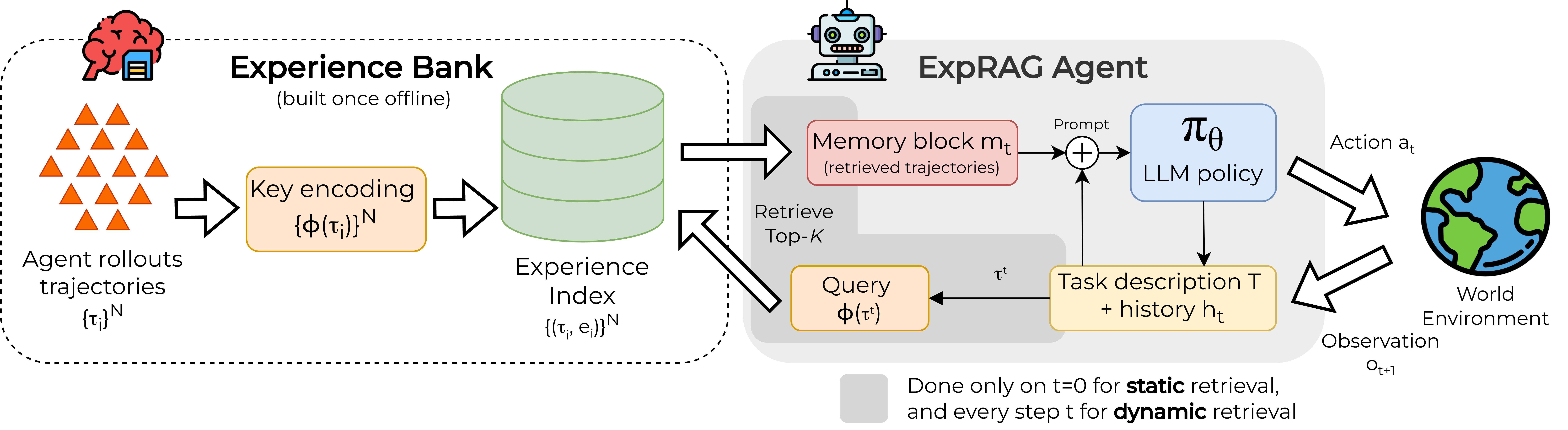
Retrieval-Augmented LLM Agents: Learning to Learn from Experience
EMNLP, 2026 & MemAgents @ ICLR, 2026
TL;DR: We investigate a strong baseline for LLM Agents Memory: retrieving experience from similar tasks. We show that LLM agents generalize better to never-before-seen tasks when they are trained not only to act, but also to use retrieved experience during training. We analyses key choices behind effective experience retrieval fine-tuning.
-

Observable Patterns Are Not Explanations: A Causal-Geometric Analysis of Latent Reasoning Models
EMNLP, 2026
TL;DR: Latent reasoning models can display human-observable patterns that look like reasoning but are not causally needed for the output, thus not evidence of mechanism. We argue that latent thoughts should be treated as hidden computation, not hidden explanation, and that LRM interpretability needs matched controls and causal interventions.
-

LLM Self-Correction with DeCRIM: Decompose, Critique, and Refine for Enhanced Following of Instructions with Multiple Constraints
EMNLP, 2024 & Sys2Reasoning @ NeurIPS, 2024
TL;DR: Introducing RealInstruct to evaluate LLMs on real multi-constrained instructions, and DeCRIM self-correction that improves instruction following by decomposing requests and refining responses, enabling open LLMs to outperform GPT-4 with strong feedback.
-

Multilingual DistilWhisper: Efficient Distillation of Multi-task Speech Models via Language-Specific Experts
ICASSP, 2024
TL;DR: Proposes a lightweight adaptation method bridging the gap between small and large speech models on under-represented languages by leveraging language-specific experts and knowledge distillation, outperforming fine-tuning and LoRA with minimal overhead.
-

ZeroBERTo: Leveraging Zero-Shot Text Classification by Topic Modeling
PROPOR, 2022
TL;DR: ZeroBERTo combines topic modeling with language models for zero-shot text classification, overcoming input size limitations and reducing runtime, achieving a 12% better F1 score and 13x faster inference compared to XLM-R on a Portuguese benchmark.